Following the fighting in the Aleppo region, the north-east of Syria has been marked for several days by fresh clashes between the Syrian Democratic Forces (SDF) and government forces, particularly in the Deir-ez-Zor and Raqqa regions. This deterioration in the security situation is having a major impact on people’s living conditions and complicating access to healthcare.
Faced with this situation, the medical NGO Mehad has adapted its activities to ensure the continuity of essential care. After an interruption in certain services, all Mehad facilities in Raqqa and Deir ez-Zor are once again receiving patients and providing their services as usual, although a drop in the number of beneficiaries has been noted at the National Hospital in Raqqa due to travel constraints.

Providing life-saving care in all circumstances
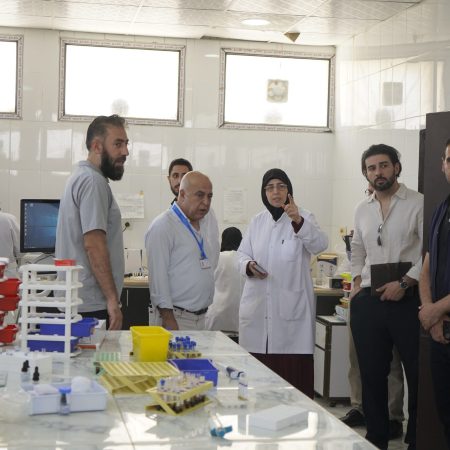
While some services have been temporarily adjusted, vital care remains a priority. At the National Hospital in Raqqa, the blood bank has remained fully operational to meet the increased need for transfusions to treat those wounded in the fighting. In north-east Syria, the Al-Hol maternity hospital, run by Mehad in the province of Hassakeh, is now the only suspended activity, due to the displacement of the clashes; it continues, however, to handle emergency deliveries.
In addition to the operational disruption, Mehad has also suffered the direct impact of the security situation. One of the NGO’s employees was the victim of an attack at his home, during which professional equipment was stolen. In addition, a Mehad training centre was looted during the fighting.
More displaced people without shelter or food
This renewed tension has led to further massive population movements. Following major population movements from Aleppo to Afrin in mid-January, people are now moving from Ar-Raqqa, Tabqa and Thawra to the governorates of Al-Hasakeh and Qamishli. The newly displaced families – around 10,400 people according to the latest figures – are arriving in particularly difficult winter conditions, facing severe shortages of shelter, food and fuel for heating.
In response to these new needs, Mehad’s mobile clinics are already deployed and fully operational among displaced populations in northern Syria. A mobile clinic is currently operating in rural areas of Aleppo, particularly in Midaneki and Afrin. The team, made up of six health professionals, has already provided almost 150 consultations, mainly in primary healthcare, monitoring chronic illnesses and dealing with urgent cases.
Despite the unstable security situation, Mehad remains fully mobilised alongside the population to ensure access to essential healthcare and to adapt its humanitarian response to changing needs on the ground.