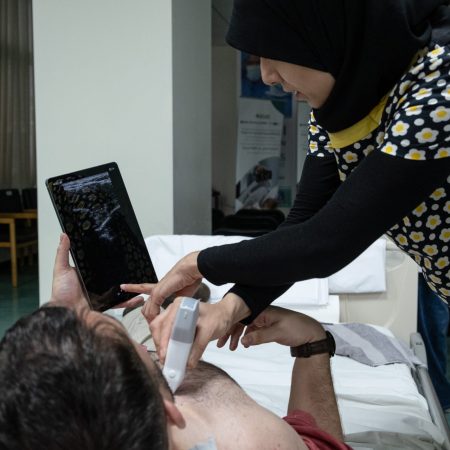
In Syria, the war has claimed many victims and forced almost half the population to flee. While the overthrow of the regime last December has enabled many Syrians to return home, millions are still displaced within the country or are refugees in neighbouring countries and elsewhere in the world.
The war that has ravaged Syria since 2011 has led to the largest forced displacement crisis in the world, according to the United Nations. More than 14 million Syrians have been forced to flee their homes, half the pre-war population. Some have become refugees, meaning they have left their country to seek refuge in another. According to the 1951 Geneva Convention, a refugee is a person who has been forced to flee his or her country as a result of persecution, war or violence. Being a refugee gives these people a number of rights, including the right not to be sent back to their country of origin.
It is estimated that during the fourteen years of war, some 6.2 million Syrians fled to neighbouring countries such as Turkey, Lebanon, Jordan, Iraq and other parts of the world. With 2.8 million people, Turkey still hosts the largest number of Syrian refugees. Lebanon and Jordan also host large numbers, with some 755,000 and 564,000 refugees respectively. Of the countries that do not border Syria, Germany takes in the most Syrian refugees. Since the fall of Bashar al-Assad’s regime in early December 2024, more than 300,000 Syrians have returned home, despite the difficult conditions and devastated infrastructure.
Internally displaced persons in Syria: a highly vulnerable population
An internally displaced person (IDP) has also fled his or her home as a result of war, violence or natural disaster, but has not crossed an international border. Unlike refugees, IDPs remain under the protection of their own government and do not benefit from the protection of international law. According to the United Nations refugee agency (UNHCR), 7.4 million people are still displaced within Syria: of these, 5.2 million have found refuge in local communities and 2.1 million live in sites or camps for displaced people.
Mainly concentrated in north-west Syria, internally displaced people are living in very precarious conditions. For those living in the camps, the living conditions, in often inadequate shelters, are extremely difficult. Many have been displaced many times and are particularly vulnerable. According to the United Nations, almost 90% of the Syrian population is in need of humanitarian assistance, a figure that illustrates the scale of the crisis prevailing in the country.
Urgent need for humanitarian aid
Since November 2024, recent events have triggered massive new displacements, with more than 880,000 internally displaced people returning to their places of origin. These population movements bear witness to the instability that still prevails in the country but also, and above all, to the resilience and desire of the displaced people to rebuild their lives despite very difficult conditions.
Syria continues to face a major humanitarian crisis, despite the hopes raised by recent events. The scale of the population’s needs means that aid must be stepped up urgently. People are in vital need of essential services such as healthcare, adequate shelter and access to drinking water.
The duration of the war has worsened the situation of Syrians, whether internally displaced or refugees abroad. The prolongation of these forced displacements is leading to great poverty and increased vulnerability. Today, humanitarian aid and protection are essential to meet the needs of millions of Syrians and support their resilience in the face of the current challenges.